
Fill-finish: the bottleneck nobody wants to build
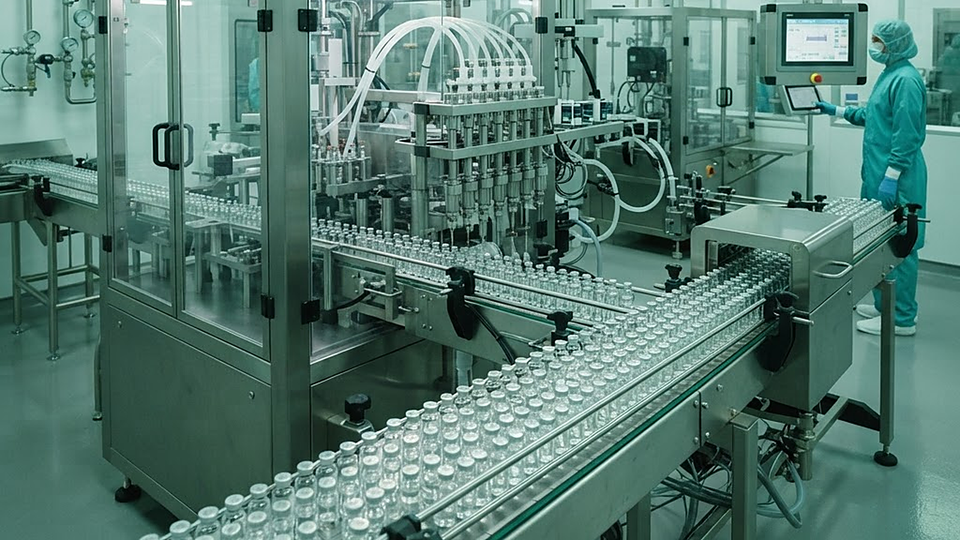
Ask a vaccine developer what almost killed their pandemic program and the answer is rarely the biology. It is the last mile of manufacturing: fill-finish, the unglamorous process of putting drug substance into vials, stoppering them, and inspecting every single unit. Lonza and its peers in the contract manufacturing world have said plainly that fill-finish capacity is booked years ahead. It is the least discussed constraint in biotech, and one of the most binding ones.
Why the bottleneck exists
Fill-finish fails to attract capital for reasons that are structural, not accidental. The facilities are capital-intensive, with sterile filling lines costing into the hundreds of millions. The margins are thin relative to drug substance manufacturing. Demand is boom and bust: swelled by pandemic funding, then stranded when the emergency orders end, which is exactly the experience of the companies that built capacity for COVID and spent years digesting the overhang. An investor who watched 2021's lines sit half idle in 2023 has a rational aversion to funding 2026's.
The consequence is a queue. Every new vaccine launch, every GLP-1 scale-up that borrows injectable capacity, every pandemic preparedness contract competes for the same certified lines. Novel modalities make it worse: mRNA's cold chain, cell therapies' individualized batches, and high-potency products requiring dedicated suites all fragment the capacity that does exist into incompatible pools.
Why nobody wants to build it
The industry's answer to fill-finish scarcity has been vertical integration and long-term contracts, not new entrants. The capacity that was added during COVID came largely from governments paying risk premiums, and when that public money withdrew, the private case for speculative capacity reverted to weak. Building a filling line on speculation means betting that a client will come with a product needing exactly your configuration, at your certification level, when your line is ready. It is infrastructure investing with biotech volatility.
There are credible policy answers: underwriting reserved surge capacity the way states underwrite reserve power plants, paying retainer fees for warm lines that sit validated but idle between pandemics. There are credible technology answers too: automated inspection and robotic filling reduce the labor constraint, and modular disposable-fill systems cut changeover times. Neither addresses the core problem, which is that nobody earns a return on capacity that waits.
What to watch
Three signals matter. Whether any government converts preparedness rhetoric into standing fill-finish retainers. Whether AI-era biotechs, with their compressed discovery timelines, start hitting manufacturing queues that turn a two-year discovery win into a four-year launch delay. And whether any major CDMO breaks the industry's silence with a speculative mega-facility, which would be the first real market verdict that the bottleneck has become the business opportunity.
The brief: Fill-finish capacity is booked years ahead, and the economics that caused the shortage have not changed. Governments underwrite surge capacity or the next pandemic discovers the queue at the worst possible moment. Watch for retainer contracts and speculative CDMO builds.
Member discussion